In 12th century Western Europe, the towns of Arras, Douai and Lille in Flanders, together with Cambrai and Tournai and Valenciennes in Hainault were the main producers of woollen cloth. Arras also served as the main commercial centre with Montreuil as its port. A high proportion of the cloth was made from English wool. England also had a flourishing woollen cloth industry at this time and exported both cheap and luxury cloth to Europe in competition with the Low Countries. The English centres of production then were Oxford, Stamford and Lincoln.
Wool dominated the English export trade from the late thirteenth century until its decline in the late fifteenth century. The industrialised areas of the Low Countries could not have existed without importing English wool, particularly for the making of luxury cloths. This trade reached its peak in the late thirteenth and early fourteenth centuries when it is estimated 40-45,000 sacks of wool were exported annually. To ensure continuity of supply and price stability, European buyers, the majority of whom were Italian merchant bankers, entered sophisticated advance contracts for the purchase of wool from the largest English producers. Cistercian monasteries predominated, although there were also lay producers. Contracts could be as long as twenty years. The monasteries were paid large sums in advance, enabling them to carryout building works and pay the royal and papal taxes. The advances paid were loans and the merchants gained ‘interest’ on the loans by paying hugely discounted prices for their wool. The average value placed on a sack of wool by these contracts was 20% below the open market price when these contracts were signed. This discount received by the buying merchant represented the interest on the loan, or up-front payment to the wool supplier. Usury, the charging of interest on loans was forbidden and is one example of how lenders charged for loans without calling the charge ‘interest’.
In the early 13th century, the woollen cloth industry moved to the north to Ghent and Ypres in Flanders. Bruges succeeded Arras as the commercial centre. The scale of cloth manufacture increased enormously in the 13th century and reached its highest point at the beginning of the 14th. It continued to be sustained by exports of English wool. Sales of cheaper cloths from Ghent and Ypres declined suddenly around 1320; Ypres was particularly hard hit economically. The variety of its fabrics made for export declined; worsteds were still exported to Norwich and its trade with the Baltics continued.
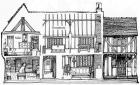
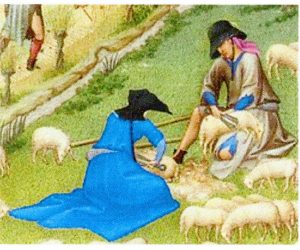
In the late 14th century production of luxury woollen cloth for export began again in England. The quantity of wool produced in England rose considerably after the Black Death, with more land turned over to sheep due to the shortage of labour. The oldest part of Little Hall, built about 1390, coincides with this increase in exports of cloth. Exports of wool to Europe fell, as much of the high-quality wool was purchased by English clothiers for cloth making.
Bibliography
- Peter Spufford Power and Profit: The Merchant in Medieval Europe
- Adrian R Bell, Chris Brooks, Paul Dryburgh: Interest Rates and Efficiency in Medieval Wool Forward Contracts
- Richard Britnell: The Woollen Textile Industry of Suffolk in the Later Middle Ages